
Jewish Inclusion
Employers are missing the absolute basics when it comes to preventing antisemitism in the workplace and fostering inclusion for Jewish staff. This is happening against a backdrop of rising antisemitism and antisemitic violence in the UK. According to all of the latest statistics, antisemitism is at an all time high in the UK.
As of September 2026, half of Jewish professionals feel excluded and left out by their organisation’s DEI efforts, and only one third feel supported at work in terms of being Jewish. Three quarters of Jewish professionals working in the UK say their workplace offers no antisemitism training and that there is no Jewish staff network.
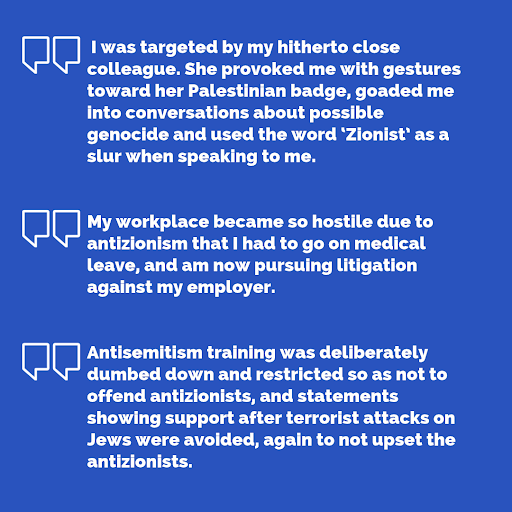
At the same time, antisemitism at work is getting worse, and people don’t trust the reporting process. 44% say negative experiences at work have risen since 7 October 2023, and 42% either have little confidence that an official report would be taken seriously, or say that there is no point reporting. Jewish professionals are hiding who they are at work, staying silent and, in some cases, leaving jobs or being pushed out.
There is a sense that senior staff and the DEI department at best do not understand antisemitism, or more worrying may be choosing not to take antisemitism seriously.
How do I know this?
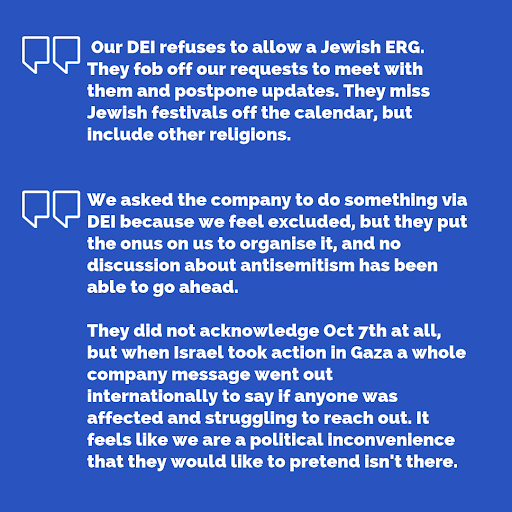
In September 2026, in conjunction with the Jewish Legal Network, I put together a survey to learn what it was like for Jewish professionals at work in the UK, what they were doing about antisemitic issues they were facing, and their wider experiences of being Jewish in the UK. I sought to discover how organisations were meeting the challenge of antisemitism, and how they were approaching Jewish inclusion.
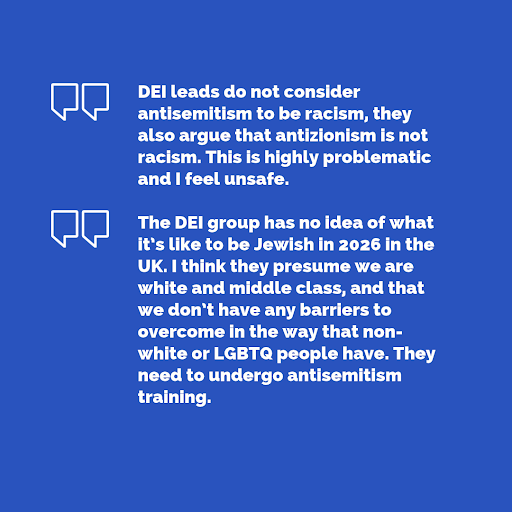
The results made worrying and bleak reading. The comments from respondents about their experiences at work and in their wider lives are at times distressing, and highly illustrative of what the Jewish community is going through.
Why have Jewish inclusion and preventing antisemitism been overlooked in the world of work?
To be frank, the prevalence of beliefs in antisemitic tropes that Jewish people are all white, privileged, too powerful, and even oppressors, have become mainstream and acceptable.
The rising acceptance and prevalence of antizionism as a valid point of view, alongside the demonising of anyone who supports Israel’s right to exist and the right of Jewish people to self-determination and safety, has added fuel to the fire.
Why would inclusion efforts need to include Jews if these beliefs are held by senior staff, HR or inclusion departments?
It is also the case that Jewish people are only 0.5% of the British population, which means that in many workplaces, Jews are a tiny minority. It doesn’t seem to matter that Jewish people are 9 times more likely, per capita, to be the victim of a hate crime compared to a Muslim (2026 UK Home Office Statistics).
This needs to change. Employers who offer no antisemitism training, no Jewish network and whose route for reports of antisemitism is one that many have little confidence in, are exposed, potentially legally and certainly in terms of losing talent and having a far from ideal culture.
From the top down, action is needed to make workplaces safe, inclusive places for Jewish staff. A significant part of this will need to involve deconstructing antisemitic tropes, and ensuring that DEI departments and senior staff understand and take antisemitism seriously.
If you are a senior leader, a DEI, HR or learning & development lead and you are ready to take action to prevent antisemitism and make your workplace inclusive of Jewish staff, let’s talk.
What training do I offer in this area?
Fostering Jewish Inclusion and Preventing Antisemitism in the Workplace
What does it mean to be Jewish? A brief education on Jewish history, including the Jews as a people, an ethnicity and a religion.
What is antisemitism? Understanding antisemitic tropes and harmful stereotypes about Jews. The IHRA definition, and recent real-world examples of antisemitism to illustrate the definition.
Does the IHRA definition stifle or even prevent criticism of Israel? How to criticise Israel without being antisemitic.
What does the data say? The latest numbers about the scale of antisemitism globally and in the UK. The findings of my September 2026 research specifically into antisemitism in the workplace in the UK. What are Jewish professionals experiencing at work in the UK, and in their wider lives?
What organisations can do in practical terms to ensure they are deliberately inclusive and supportive of their Jewish staff. Where to focus initiatives for the most positive impact. Practical tips for supporting staff experiencing antisemitism, and advice for allyship towards Jewish colleagues.
Collective and individual commitments as a result of today’s session. Suggestions for books, articles and other resources to extend today’s learning.
This can be delivered as a 60-90 minute in person, hybrid or online training, with myself and Steven Phillips of JewishERGs. Please note that this training session is not a space to discuss political issues relating to the Middle East. Efforts to divert the conversation in this direction would be politely and firmly closed down.
Why Harriet for this training?
From her gender equity work, Harriet is used to difficult and emotive conversations, and is not afraid to tackle and moderate important but difficult conversations. Her outspoken pieces on social media frequently go viral and lead the conversation, whether they are about sexism or antisemitism, and she has had to become used to dealing with trolls and bad faith actors.
On top of her work supporting organisations round gender equity, post October 7th 2023, Harriet found herself being contacted by many Jewish women about an increasingly challenging and even exclusionary environment in their workplaces for Jews, and heard many stories of DEI departments being somewhere between dismissive or lacking in understanding on the matter, or at worst, overtly antisemitic themselves.
In 2024 she hosted a series of support and solidarity calls for Jewish professional women, giving her a fresh breadth of understanding of what Jewish professionals were facing. Harriet also began writing and speaking about antisemitism online. In 2025, Harriet delivered organisational training alongside Hira Ali on tackling antisemitism and islamophobia in the workplace.
Harriet has reported local incidents of antisemitism three times to her local police in 2026. Hearing similar stories from many of her Jewish connections about their experiences as well as seeing the escalating situation unfold nationally and internationally, Harriet now dedicates some of her working focus to tackling antisemitism and supporting organisations to be fully inclusive of their Jewish staff.

Creating the UK 2026 Antisemitism and Antizionism At Work Survey and Report has given Harriet deep insights into what Jewish professionals are facing inside and outside work in the UK, and the shortcomings of most organisations when it comes to supporting their Jewish staff. The recommendations she makes in the report for workplaces to prevent and tackle antisemitism, and to foster proper Jewish inclusion are comprehensive.
“Harriet has been a big part of Rise - a group for gender diversity in media technology - mentoring programme. Delivering her powerful sessions has helped empower and inspire over 50 women so far in the programme. Her sessions are full of wit and compassion offering essential life skill toolkits that each participator can use to their own accord. The focused and carefully crafted sessions for these mid career women has left them with the drive and confidence to do push forward and owning their brilliance in both professional and personal life.“
NIC KEMP: Rise Mentoring Programme Manager